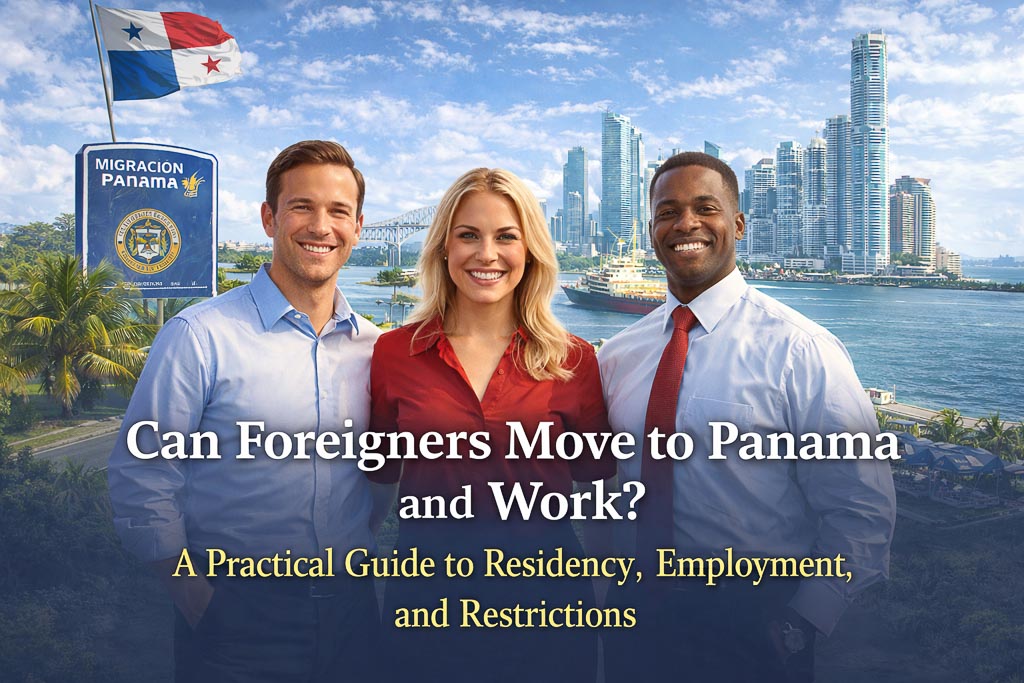
Can Foreigners Move to Panama and Work? A Practical Guide to Residency, Employment, and Restrictions
Panama continues to attract a growing number of expats, investors, and remote professionals looking for a stable, dollarized economy and a straightforward path to residency. But one of the most common—and often misunderstood—questions is simple:
Can you move to Panama and work?
The answer is yes—but with important distinctions. Panama is open to foreign residents, but it is also highly protective of its local labor market. Understanding how residency, work permits, and professional restrictions interact is essential before making any decisions.
Working in Panama
The first thing to understand is that Panama separates three concepts:
- Residency (immigration status)
- Work authorization (labor permit)
- Professional eligibility (what jobs you’re legally allowed to do)
You can have residency and still not be allowed to work locally. Likewise, you can legally live in Panama while working remotely without entering the local job market.
The Easiest Path: Remote Work
For most foreigners, the simplest and most common setup is:
- Living in Panama
- Earning income abroad
This avoids the need for a local work permit entirely, as you are not competing in the Panamanian labor market. It’s the structure behind the rise of digital nomads, consultants, and location-independent professionals choosing Panama.
Working Locally: Permits and Limitations
If you intend to work for a Panamanian company, you will need:
- A valid residency status
- A work permit issued by the Ministry of Labor
- Even then, companies face hiring restrictions. In most cases:
- Only 10% of a company’s workforce can be foreign
This quota alone makes local employment more competitive for foreigners unless they bring specialized skills or fill roles not easily sourced locally.
Permanent Residency Pathways and Their Implications
Panama offers several residency options, many of which can lead to permanent residency. However, not all automatically grant the right to work.
Friendly Nations Visa
One of the most popular pathways
- Requires economic ties (employment or company ownership)
- Can lead to permanent residency
Important:
Residency alone does not equal work authorization—you still need a separate work permit.
Qualified Investor Visa
- Based on real estate or financial investment
- Fast-track to permanent residency
Limitation:
Does not automatically grant the right to work locally
Digital Nomad Visa
- Designed for remote workers
- Requires foreign income
Limitation:
You cannot work for a Panamanian employer
Professional Residency (for certain degrees)
- Available for foreigners with recognized university degrees
Critical restriction:
Only applies to professions not reserved for Panamanians
Protected Professions in Panama
This is where many people run into issues.
Panama has a long-standing legal framework that reserves certain professions exclusively for Panamanian citizens, regardless of residency status.
These protections are rooted in Article 20 of the Panamanian Constitution
Various sector-specific laws regulating each profession
There are dozens of restricted professions, covering major sectors such as:
- Law (Law 9 of 1984)
- Accounting (Law 57 of 1978)
- Engineering and architecture (Executive Decree 257 of 1965)
- Medicine, dentistry, nursing (various health laws)
- Pharmacy (Law 24 of 1963)
- Psychology (Law 56 of 1975)
- Journalism and social sciences
In total, Panama restricts dozens of professions—often cited at 50+—to citizens only
What This Means in Practice
Even if you:
- Have permanent residency
- Have decades of experience
- Hold advanced degrees
You still cannot legally practice in these professions unless you are a Panamanian citizen.
This is one of the most important realities to understand upfront.
So What Can Foreigners Actually Do?
Despite these restrictions, there are still many viable paths:
- Remote work: Most flexible and common option
- Business ownership: You can own and operate a company. You may need a work permit to be actively employed within it
- Non-restricted employment: Sales, hospitality, tech, management, and many private-sector roles remain open
- Consulting / advisory roles: Often structured outside regulated professionsv
The Reality on the Ground
Panama is open—but structured.
It welcomes:
- Investors
- Entrepreneurs
- Remote professionals
But it also:
- Protects local jobs
- Restricts key professions
- Controls foreign hiring through quotas
This creates a system where opportunity exists—but must be navigated correctly.
Final Thoughts
Moving to Panama and working here is absolutely possible—but it requires clarity on what “working” actually means in your case.
- If your income is external → the path is straightforward
- If you want to work locally → permits and restrictions apply
- If you’re in a regulated profession → verify eligibility early
The most successful relocations are the ones that align structure with reality from the start.