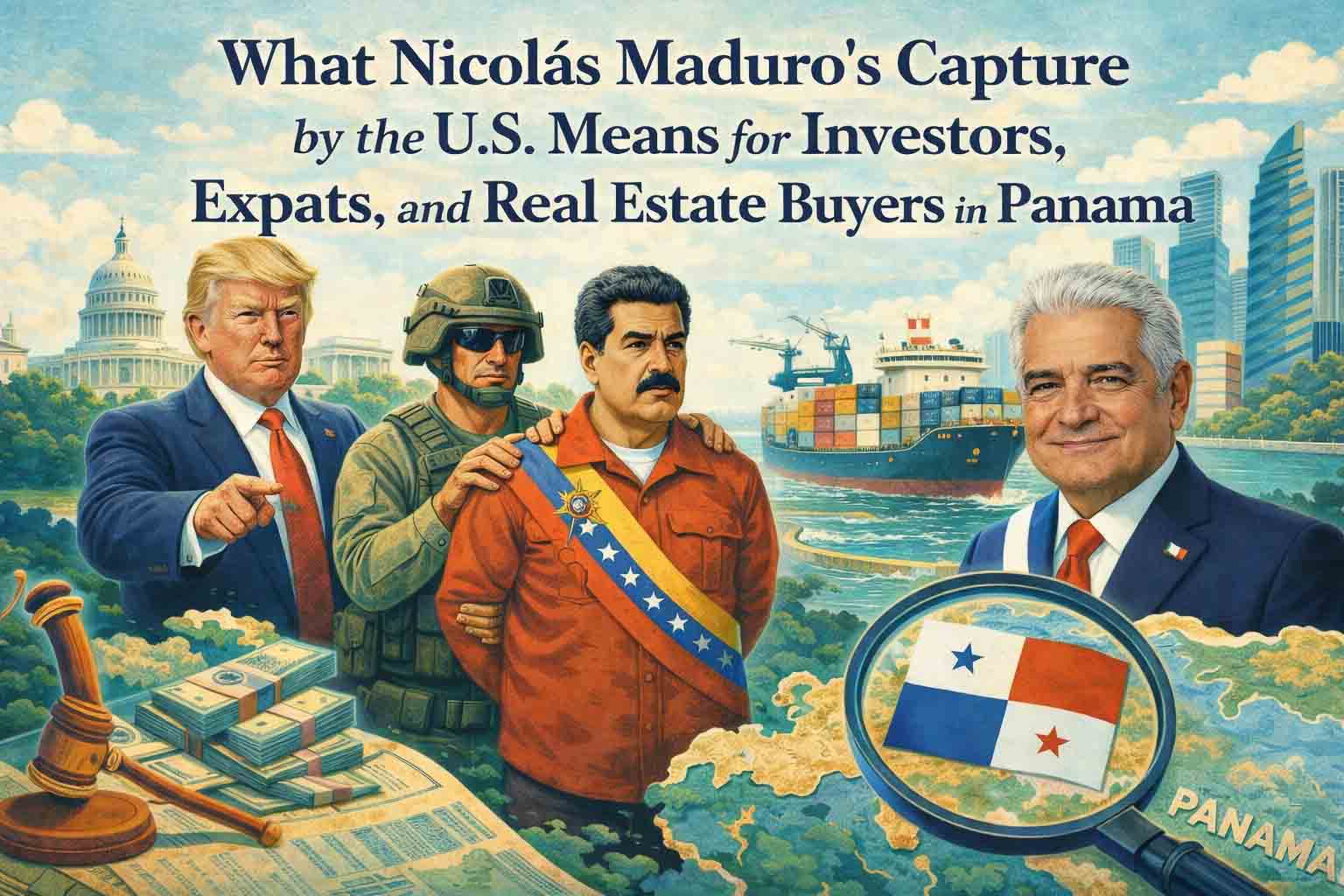
What Nicolás Maduro’s Capture by the U.S. Means for Investors, Expats, and Real Estate Buyers in Panama
A note on timing and complexity…
Latin American regional dynamics are highly complex, fluid, and fast-moving. Political alignments, policy responses, and second-order effects can shift quickly. The analysis below reflects how conditions appear today, not a guarantee of how they will look tomorrow. For investors and relocation-minded buyers, context matters as much as headlines.
For those evaluating Panama as an investment, residency, or relocation destination, the reported capture of Nicolás Maduro by the United States naturally raises questions. Does this event materially change Panama’s risk profile? Does it affect capital flows, migration patterns, or property demand? Or is it largely a regional shock with limited direct relevance?
The short answer: this is not a structural negative for Panama, but it is a reminder of why Panama’s value proposition has always been stability, predictability, and insulation from regional volatility.
Why Panama Looks Different Through An Investor Lens
Panama’s appeal to international investors and expatriates rests on the country’s fundamentals:
- a dollarized economy
- a globally critical logistics asset (the Canal)
- an outsized services sector (banking, law, shipping, trade)
- long-standing institutional ties with the United States
Unlike Venezuela, Panama is not an adversarial state, nor is it isolated from global markets. On the contrary, it is deeply embedded in them. That distinction is essential when assessing whether dramatic regional headlines translate into local risk.
Politics: Alignment And Continuity Matter
The capture aligns with the assertive foreign-policy posture associated with Donald Trump and occurs under a Panamanian administration led by José Raúl Mulino, who has publicly opposed the Maduro regime and emphasized democratic legitimacy.
For investors, the key point is not rhetoric—it’s continuity. Panama’s current government signals cooperation with the U.S. and international institutions, reinforcing the legal and diplomatic framework that underpins:
- property rights
- capital mobility
- immigration and residency programs
That alignment generally reduces, not increases, systemic risk for foreign capital.
Migration Dynamics And Real Estate Demand
Panama has absorbed a significant Venezuelan diaspora over the past decade. This matters for real estate and relocation buyers because migration trends affect:
- rental demand in urban cores
- neighborhood demographics
- long-term absorption of mid-market and premium housing
Short term, heightened uncertainty around Venezuela can increase temporary migration pressure and reinforce Panama’s role as a safe regional destination. Medium to long term, outcomes depend on Venezuela’s trajectory:
- a managed transition could slow outward migration
- prolonged instability could sustain demand for Panama as a second-residency or relocation option.
Historically, regional instability has tended to support, not undermine, Panama’s residential and rental markets—particularly in Panama City and established expat hubs.
Financial Compliance And Capital Flows
One area investors should watch is compliance tightening. Events involving Venezuela typically trigger stricter scrutiny of:
- Venezuela-linked funds
- cross-border transfers
- politically exposed persons
For most buyers and investors, this is a procedural issue, not a market risk. Panama’s regulated banking system and improving compliance standards are precisely what keep it investable. If anything, moments like this reinforce why serious capital prefers jurisdictions that are transparent and internationally aligned.
Short-, Medium-, And Long-Term Outlook For Investors
Short term (weeks to months):
Expect headlines, commentary, and some noise. No material impact on property values, ownership rights, or residency programs.
Medium term (months to two years):
Migration patterns and regional diplomacy are the main variables. Panama remains a beneficiary of stability-seeking capital and lifestyle-driven relocation.
Long term:
The lasting takeaway is not Venezuela—it’s precedent. Investors are reminded that geopolitical risk exists in the region, and that jurisdictions with strong institutions trade at a premium. Panama sits firmly in that category.
Apples And Oranges, But Not Irrelevant
Comparisons between Venezuela and Panama break down quickly at a structural level. Panama’s economy, legal system, and global role are fundamentally different. However, regional events still matter indirectly—through sentiment, migration, and capital behavior.
For investors and expats, the conclusion is straightforward: this event does not weaken Panama’s investment case. If anything, it underscores why Panama continues to attract buyers looking for a politically neutral, economically integrated, and legally predictable place to invest, live, or establish a second base.
Bottom Line For Real Estate And Relocation Buyers
Panama’s value proposition remains intact. There is no credible scenario in which this event translates into property-level risk, ownership uncertainty, or lifestyle disruption. The real risks to monitor are the same as always: policy execution, infrastructure, and global economic cycles—not regional regime change elsewhere.