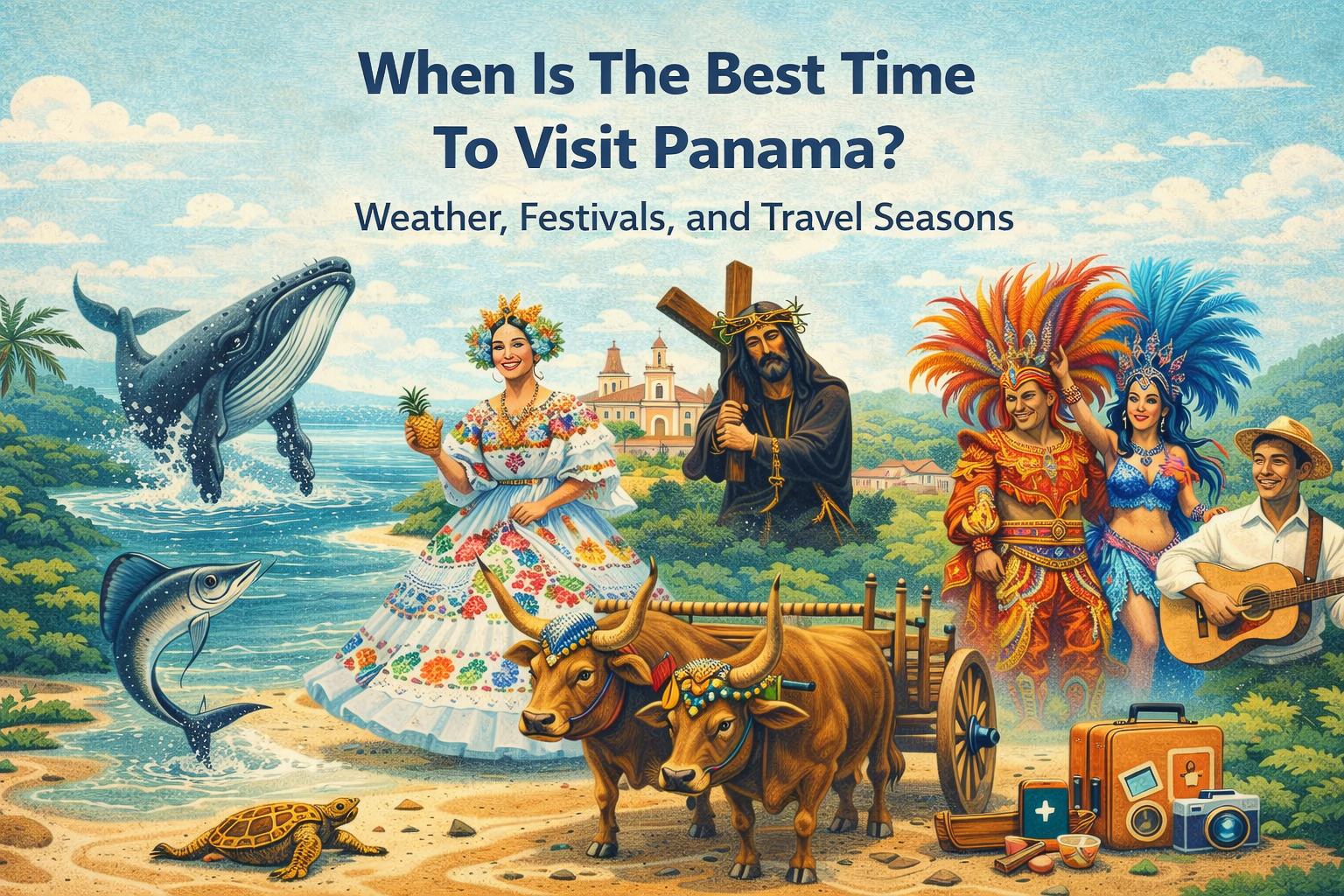
When Is The Best Time To Visit Panama? Weather, Festivals and Travel Seasons
The short answer is simple: it’s always a good time to visit Panama.
The more useful answer depends on what you want to experience.
Panama doesn’t follow a four-season calendar. Instead, the year is shaped by dry season and green (rainy) season, combined with trade winds, regional microclimates, cultural festivals, and wildlife cycles. Because of this, there is no single “best” time—only the best time for you.
From national celebrations and folkloric festivals to whale migrations, sport fishing, and sea turtle nesting, Panama offers meaningful experiences throughout the year.
Panama’s Seasons at a Glance
- Dry Season (December to April)
Lower humidity, little rainfall, steady sunshine, and stronger trade winds. - Green / Rainy Season (May to November)
Lush landscapes, warmer humidity, predictable afternoon rains, and fewer crowds.
Temperatures remain fairly consistent year-round, typically ranging from the mid-20s to low-30s Celsius (mid-70s to high-80s Fahrenheit).
Dry Season: Festivals, Music, and Sunshine (December–April)
The dry season is Panama’s most popular travel window, not just for weather, but for the concentration of major cultural and social events.
What to Expect
- Bright, sunny days with minimal rainfall
- Strong northeast trade winds, especially January through March
- Busy beach towns and active cities
- Peak season for international travel
The trade winds influence much of the Pacific coast, creating ideal conditions for sailing, kiteboarding, and certain surf breaks in areas like Punta Chame, Playa Venao, and Santa Catalina.
Key Events and Celebrations
Christmas & New Year (December)
Christmas is a family-centered holiday in Panama, marked by traditional meals, fireworks, and late-night gatherings. New Year’s Eve is widely celebrated, particularly in Panama City, coastal towns, and resort areas.
Panama Jazz Festival (January)
Held annually in Panama City, the Panama Jazz Festival is one of the country’s most internationally recognized cultural events. It attracts renowned musicians, students, and audiences from around the world, with concerts, workshops, and performances spread across multiple venues.
Carnaval (February or early March)
Panama’s most famous festival, Carnaval lasts four days leading up to Ash Wednesday. Las Tablas is the epicenter of large-scale celebrations, while many towns host smaller, more traditional festivities.
Easter / Semana Santa (March or April)
Semana Santa is observed nationwide, with religious processions in historic districts like Casco Viejo and increased domestic travel to beaches and rural areas.
Ideal For
- First-time visitors
- Beach vacations and island hopping
- Festivals and live music
- Kiteboarding, sailing, and offshore activities
- City exploration and organized tours
Green Season: Folklore, Nature, and Local Life (May–November)
Often overlooked, Panama’s green season offers some of the country’s most authentic cultural experiences and its most vibrant natural landscapes.
Rain typically falls in the afternoon or evening, leaving mornings open for exploration. The result is dramatic greenery, flowing rivers, and a slower, more local rhythm of life.
Cultural and Regional Festivals
Festival Nacional de la Pollera (Las Tablas – July)
A celebration of Panama’s national dress, featuring parades, music, dance, and elaborate traditional attire.
Festival de la Mejorana (Guararé – September)
One of Panama’s most important folkloric festivals, highlighting traditional music, dance, and rural customs. It offers a deep look into the country’s cultural roots.
Ox Cart Festival (Azuero Region, including Pedasí – dates vary)
Celebrating agricultural heritage, decorated ox carts are paraded as symbols of Panama’s rural past.
Cristo Negro Festival (Portobelo – October 21)
One of Panama’s most significant religious events. Thousands of pilgrims gather to honor the Black Christ statue, many participating in candlelit processions and religious ceremonies.
Ideal For
- Cultural and heritage-focused travel
- Photography and landscape exploration
- Smaller crowds and slower travel pace
- Long stays and immersive experiences
Wildlife, Fishing, and Natural Phenomena
Panama’s biodiversity is one of its greatest assets, and several wildlife experiences are strongly seasonal.
Whale Watching (July–October)
Humpback whales migrate to Panama’s Pacific coast to breed and give birth. Prime viewing areas include the Pearl Islands, Gulf of Chiriquí, and coastal zones near the Azuero Peninsula.
Sea Turtle Nesting (July–November)
Isla Cañas, near the Azuero Peninsula, is one of Panama’s most important turtle nesting sites. Multiple species come ashore to lay eggs, and guided nighttime visits offer a rare and responsible wildlife experience.
Sport Fishing (Year-Round, Peak Seasons Vary)
Panama is internationally recognized for sport fishing, with world-class conditions on both the Pacific and Caribbean coasts. Species such as marlin, sailfish, tuna, dorado, and roosterfish are present at different times of year. Regions like the Gulf of Chiriquí, Pedasí, and the Pearl Islands are especially well known, making fishing a year-round draw with seasonal peaks depending on target species.
What You Can Do All Year Round
Many of Panama’s highlights aren’t tied to any particular season:
- Explore Panama City’s historic districts and modern skyline
- Visit the Panama Canal and surrounding national parks
- Enjoy dining, nightlife, and cultural venues year-round
- Experience rainforest biodiversity within short drives of urban centers
- Travel easily between beaches, mountains, and cities
Panama’s geographic diversity ensures that when one region is wet or windy, another often offers ideal conditions.
So, When Is the Best Time to Visit Panama?
The best time to visit Panama depends entirely on your interests:
- Festivals, music, and sunshine: dry season
- Culture, folklore, and wildlife: green season
- Fishing, exploration, or relocation scouting: any time
Rather than offering a single perfect window, Panama offers distinct experiences throughout the year, shaped by culture, climate, and nature.
No matter when you arrive, there will always be something happening, something migrating, or something worth discovering.